Robin Hood has returned to our screens with a brand-new series from the streaming service MGM+. Once again, the arrows rain down from Sherwood Forest. This one is a grounded, origin-tilted retelling set in the tense years after the Norman Conquest.
So what is it about the legend of Sir Robin of Locksley, more than eight centuries old? What is it that lures us as it lured our parents, grandparents and ancestors before them?
Every generation rebuilds Sherwood to argue about power, fairness, love, and the price of loyalty. The screen keeps returning to him for the same reason the stories survived before cinema: the legend is designed to be retold. And the trail starts long before Hollywood, in the traditional ballads of the British Isles.
The Ancient Balladry
There are nearly forty Robin Hood entries in Francis James Child’s 19th-century anthology The English and Scottish Popular Ballads. The Robin cycle reaches at least into the 17th century in print, and much further in performance. In these songs—“A Gest of Robyn Hode,” “Robin Hood and the Monk,” “Robin Hood and Guy of Gisborne,” “Robin Hood and the Potter,” and more—the legend emerges piece by piece: Robin and his company (Little John, Will Scarlet, Friar Tuck, Alan-a-Dale, later Marian), and the ever-odious Sheriff.
Each ballad comes with variants that roamed the wild like open-source folk software: sung, reshaped, and retold by whoever spread it next. A few motifs refuse to budge. There’s the ever-present greenwood—not just a forest but a moral zone where the crown’s rules bend. There’s the outsider vs. official thread: abbots, sheriffs, and powerful landlords seldom appear as friends of the common folk. And there’s the company itself, a found family that makes the outlawry feel communal rather than solitary.
Why We Still Need Him
Robin Hood represents a tricky kind of hero: selfless yet cunning, compassionate yet ruthless when facing cruelty. He takes from the rich and gives to the poor, and he does it with style. We need Robin because—in every generation—there are Sheriffs of Nottingham for whom greed is the only compass and the oppression of the powerless their creed. Sound familiar?
Robin Hood, 2025-Style
In the new MGM+ series, Rob Hood (Jack Patten) is the son of a Saxon forester (Tom Mison). After witnessing royal abuse, he bands with Marian (Lauren McQueen) to challenge Norman power, drawing in familiar figures—the Sheriff of Nottingham (Sean Bean), Little John, Friar Tuck—amid politics, romance, and a grittier edge than the familiar swashbuckler. An origin story for the legend.
The Movie That Set My Robin Hood Compass
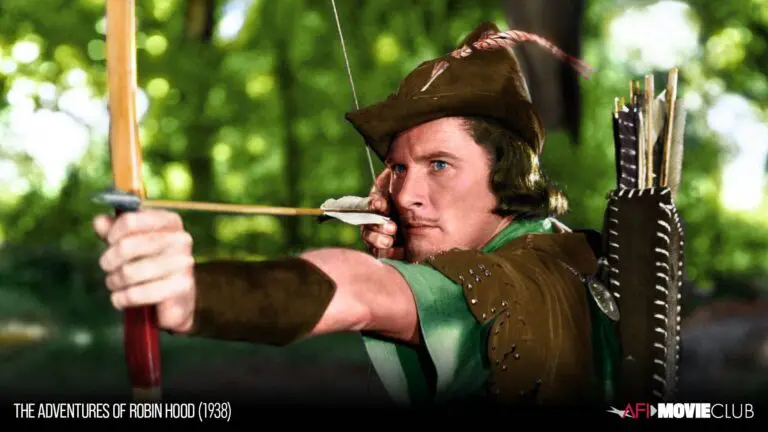
I admit it: I’m a Robin Hood snob. My earliest encounter with the Sherwood outlaw was a Sunday-afternoon Family Classics screening on WGN-TV Chicago: Errol Flynn in The Adventures of Robin Hood. To this day, Erich Korngold’s lush score can drop me straight back into Sherwood. One swell of horns, and I’m there—under the trees, boots laced, ready to cheer when the arrows fly.
Michael Curtiz’s 1938 Technicolor classic set the template: Errol Flynn’s heroic allure, Olivia de Havilland’s steel, and Korngold’s magnificent score. It minted the gold standard for the righteous outlaw with a romantic gleam—the “laughing justice” Robin: witty, acrobatic, a democrat with perfect posture. Flynn’s film codified the visual grammar: tree-borne ambushes, quarterstaff duels, banquet-table arrows that later versions echo, subvert, or gleefully reject. The legend, like the ballads before it, keeps evolving in the wild.
Since that pivotal film, neither big nor small screens have left Sherwood alone.
“Robin Hood, Robin Hood, riding through the glen…” went the earworm theme of The Adventures of Robin Hood (1955–1959). The British half-hour series, starring Richard Greene, aired on ITV and crossed the Atlantic on CBS. Behind its brisk family swashbuckler was a remarkable writers’ room: producer Hannah Weinstein hired several blacklisted Hollywood screenwriters (including Ring Lardner Jr., Waldo Salt, Robert Lees, and Adrian Scott), often under pseudonyms. The result was cheerful outlaw adventure with a sly, anti-authoritarian streak—populist fables that winked at both British and American politics breaking nary a sweat.
Aging outlaws and Melancholy Crowns
What happens when an older Robin Hood meets Marian years after the legend ends? Richard Lester’s elegiac Robin and Marian (1976) answers with Sean Connery and Audrey Hepburn as lovers reunited after the Crusades—he weathered, she now a nun. Their chemistry is tender and wry, shadowed by the cost of heroism and time. With Robert Shaw as the flinty Sheriff (and a brief turn from Richard Harris as Richard the Lionheart), the movie asks whether love and ideals can survive age, regret, and politics? It’s a melancholy “what if,” less about derring-do than about how myths fit mortal bodies.
In the 1980s, British television gave the myth a moody, numinous makeover with Robin of Sherwood (Michael Praed, then Jason Connery): pagan echoes, sorcery at the forest’s edge, and a Sheriff who is less a buffoon than a function of a cruel system. It’s the first time many viewers meet Herne the Hunter and feel that Sherwood is genuinely enchanted. Around the same time, American kids absorbed a lighter, animated catechism—Disney’s Robin Hood (1973)—where a fox with a lute and a sly smile made outlawry feel like a picnic with politics.
Robin Hood: Prince of Thieves (1991)
The ’90s delivered both earnest and irreverent waves. Kevin Costner’s blockbuster is glossy and sentimental—but his California-casual Robin (and accent drift) feels miscast. The film survives on its supporting oxygen: Morgan Freeman’s magnetic Azeem, Mary Elizabeth Mastrantonio’s flinty Marian, Christian Slater’s hot-headed Will, and a gloriously scenery-chewing Alan Rickman as the Sheriff (at times as if he’s in a better, funnier movie). Whatever its flaws, the film reset Sherwood as a global hit machine—helped mightily by a wall-to-wall MTV sheen and Bryan Adams’s chart-dominating power ballad.
Two years later and it’s Mel Brooks’ turn with Robin Hood: Men in Tights (1993), discovering that the myth survives parody because parody is one of the ways we love it. The film weaponizes the legend’s clichés: tights, archery contests, multilingual Friars, fourth-wall breaks.
Television, with its room for serial politics and soap, can stretch Sherwood in any direction. The BBC’s Robin Hood (2006–2009) went neon-leather and post-Iraq War, with a young, cocky Robin learning that insurgency is logistics as much as legend.
Later features toggled tone: Ridley Scott’s Robin Hood (2010) tried a gritty prequel-ish origin with Russell Crowe. Robin Hood (2018) aimed for comic-book dynamism with Taron Egerton, all urban-fantasy costuming and heat-map archery. It’s pure camp. (Although Ben Mendelsohn’s “Le Sheriff de Nottingham” can go scene for scene chewery with Rickman’s interpretation of the villain!)
Why the outlaw won’t retire
Across all of these interpretations and across the decades, a few questions persist. The answers tell you more about the era than the archer:
Who gets robbed and why? Early ballads target corrupt officials; modern films shift the discussion to surveillance, taxation, or private armies.
What kind of leader is Robin? A laughing captain, a traumatized veteran, an accidental symbol? Who is Marian? Sometimes she’s a prize; in better versions she’s a strategist or the moral adult.
And Sherwood? A literal forest? A digital commons? The signifier of community that eats together and fights with style? A sacred space?
Every production picks a lane, and even when it swerves, we can read the politics of the moment in its choices. What’s your favorite Robin retelling? Let us know in the comments below!
Be sure to follow me on Twitter (X) @BodiceDoublet